Isoklinker
Performance Monster
Das Non Plus Ultra ist das was am besten zur Hardware / Software passt und irgendwie TÜVbar istOook. Ich hätte jetzt vermutet, dass wenn du 4x200 fährst, dass das das (grammatikalisch korrekt?) Non-Plus-Ultra ist?


Folge dem Video um zu sehen, wie unsere Website als Web-App auf dem Startbildschirm installiert werden kann.
Anmerkung: Diese Funktion ist in einigen Browsern möglicherweise nicht verfügbar.
Das Non Plus Ultra ist das was am besten zur Hardware / Software passt und irgendwie TÜVbar istOook. Ich hätte jetzt vermutet, dass wenn du 4x200 fährst, dass das das (grammatikalisch korrekt?) Non-Plus-Ultra ist?

Cobb stage 2 agressiv ST, aufm prüfstand noch ohne llk, jetzt mit llk von wagner evo1 und hab jetzt stage 2agr ST + FMIC.Welche cobb 2 map fährst du denn? Modifikationen an Ansauganlage,LLK und AGA?
I
Für Dienstag habe ich einen Termin gemacht, dann kommt der 2x200 HJS Metall raus und der 2x400 Keramik wieder rein. Vorkat bleibt erst mal leer. Mal schauen, was es bringt.


Gute entscheidung, welche software hast du den aktuell drauf?Ich war heute bei BMW und habe den Fehlerspeicher auslesen lassen. Ich hatte gehofft, dass ich dort etwas wegen dem unschlüssigem Drehmoment finden würde, aber ohne Ergebnis. Es wurde nun das Getriebe zurückgesetzt, sodass es sich neu "anlernt".
Für Dienstag habe ich einen Termin gemacht, dann kommt der 2x200 HJS Metall raus und der 2x400 Keramik wieder rein. Vorkat bleibt erst mal leer. Mal schauen, was es bringt.
und nicht vergessen die Adaptions Werte von der DME zurückzusetzen
Gute entscheidung, welche software hast du den aktuell drauf?
Die Adap-was von DME-wer? Meinst du, den Serienstand von der Motorsoftware zurückspielen?

The following excerpts are from Jay Kavanaugh, a turbosystems engineer at Garret, responding to a thread on http://www.impreza.net regarding exhaust design and exhaust theory:
“Howdy,
This thread was brought to my attention by a friend of mine in hopes of shedding some light on the issue of exhaust size selection for turbocharged vehicles. Most of the facts have been covered already. FWIW I'm an turbocharger development engineer for Garrett Engine Boosting Systems.
N/A cars: As most of you know, the design of turbo exhaust systems runs counter to exhaust design for n/a vehicles. N/A cars utilize exhaust velocity (not backpressure) in the collector to aid in scavenging other cylinders during the blowdown process. It just so happens that to get the appropriate velocity, you have to squeeze down the diameter of the discharge of the collector (aka the exhaust), which also induces backpressure. The backpressure is an undesirable byproduct of the desire to have a certain degree of exhaust velocity. Go too big, and you lose velocity and its associated beneficial scavenging effect. Too small and the backpressure skyrockets, more than offsetting any gain made by scavenging. There is a happy medium here.
For turbo cars, you throw all that out the window. You want the exhaust velocity to be high upstream of the turbine (i.e. in the header). You'll notice that primaries of turbo headers are smaller diameter than those of an n/a car of two-thirds the horsepower. The idea is to get the exhaust velocity up quickly, to get the turbo spooling as early as possible. Here, getting the boost up early is a much more effective way to torque than playing with tuned primary lengths and scavenging. The scavenging effects are small compared to what you'd get if you just got boost sooner instead. You have a turbo; you want boost. Just don't go so small on the header's primary diameter that you choke off the high end.
Downstream of the turbine (aka the turboback exhaust), you want the least backpressure possible. No ifs, ands, or buts. Stick a Hoover on the tailpipe if you can. The general rule of "larger is better" (to the point of diminishing returns) of turboback exhausts is valid. Here, the idea is to minimize the pressure downstream of the turbine in order to make the most effective use of the pressure that is being generated upstream of the turbine. Remember, a turbine operates via a pressure ratio. For a given turbine inlet pressure, you will get the highest pressure ratio across the turbine when you have the lowest possible discharge pressure. This means the turbine is able to do the most amount of work possible (i.e. drive the compressor and make boost) with the available inlet pressure.
Again, less pressure downstream of the turbine is goodness. This approach minimizes the time-to-boost (maximizes boost response) and will improve engine VE throughout the rev range.
As for 2.5" vs. 3.0", the "best" turboback exhaust depends on the amount of flow, or horsepower. At 250 hp, 2.5" is fine. Going to 3" at this power level won't get you much, if anything, other than a louder exhaust note. 300 hp and you're definitely suboptimal with 2.5". For 400-450 hp, even 3" is on the small side.”
(...)
Other things you can do (in addition to choosing an appropriate diameter) to minimize exhaust backpressure in a turboback exhaust are: avoid crush-bent tubes (use mandrel bends); avoid tight-radius turns (keep it as straight as possible); avoid step changes in diameter; avoid "cheated" radii (cuts that are non-perpendicular); use a high flow cat; use a straight-thru perforated core muffler... etc.”
(...)
As you can see, the backpressure penalty of running a too-small exhaust (like 2.5" for 350 hp) will vary depending on the match. At a given power level, a smaller turbo will generally be operating at a higher turbine pressure ratio and so will actually make the engine more sensitive to the backpressure downstream of the turbine than a larger turbine/turbo would. As for output temperatures, I'm not sure I understand the question. Are you referring to compressor outlet temperatures?
Weil es hier einige male angesprochen wurde: Die Turbos bedürfen keinerlei Gegendruck, das ist ausschließlich Sache der (Software) Abstimmung, insbesondere der Ladedruck Regulierung.
Anbei ein interessantes Statement hierzu:

Weil es hier einige male angesprochen wurde: Die Turbos bedürfen keinerlei Gegendruck, das ist ausschließlich Sache der (Software) Abstimmung, insbesondere der Ladedruck Regulierung.
Man findet zu dem Thema allerlei im Netz und wie ich auch geschrieben


Ergebnis war eine rutschende Kupplung beim DKG. Ich hatte hier intensive Unterstützung eines Mitgliedes. Heraus kam, dass das DKG ab 550nm ein unschlüssiges Drehmoment ausgibt und der Kraftschluss nicht mehr passt. Das Drehmoment wurde vorerst auf 544nm beschränkt.
Hier habe ich ein Video der rutschenden Kupplung bei 576nm aufgenommen:
Wegen dem fehlenden Druck: Ich hatte ja nun etwas Zeit, mich mit dem Thema Abgasanlage auseinanderzusetzen. Nach dem was ich mir angelesen habe, scheint der Gegendruck zu fehlen, sodass das unverbrannte Frischgas nicht zurück in den Zylinder gedrückt wird und die Füllung nicht optimal ist. Daher vielleicht der subjektive Eindruck, dass das Auto nicht aus dem Quark kommt?
Aktueller Stand:
Neue Abgasanlage
Software von Zoran
2x200 HJS Metallkats
Vorkats in Downpipes entfernt und durch Rohr ersetzt
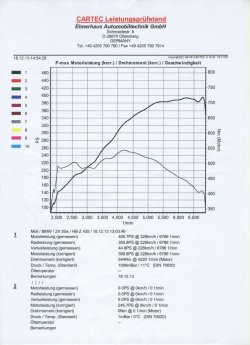
396 PS bei 5999 U/min und 544 Nm bei 4200 U/min

Jürgen, was hat dir denn deine X-Pipe gebracht?
Ist das eine Supersprint?
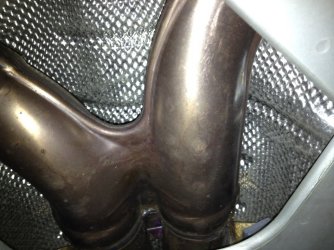
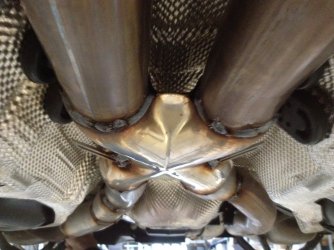

Gemessen wurde jetzt mit 388PS und 544nm in der Spitze.
.
...naja könnte besser sein aber ich glaube nach dem ganzen Theater, ist man froh wenn es einiger maßen passt 
Oh, schade.
wenn ich alles auf „Ballett“ stelle brennt der Baum 

Gemessen wurde jetzt mit 388PS und 544nm in der Spitze.